
If you're just starting solids with your 6 month old baby, you may be wondering what a feeding schedule should look like. Should you still be feeding breastmilk or formula? I'll show you what to expect with milk feeds and complimentary foods when you're first starting solids, and give a you a sample feeding schedule for 6 months of age.

This post has been written and medically reviewed by Kaleigh McMordie, MCN, RDN (Registered Dietitian Nutritionist).
As babies start transitioning from breastmilk or formula to solids, you may be wondering how feeding schedules will change. After all, the goal is to have baby well on the way to eating age appropriate solid foods alongside the family by 12-18 months of age (though not necessarily exclusively solids). But that doesn't mean we cut off all milk feeds, or even replace one or two feeds with meals, as soon as we start offering solids.
Jump to:
How Do Milk Feeds Change When Starting Solids?
When your baby is ready to start solids, usually around 6 months of age, it is likely that your milk feeds will not change much, if at all, for the next 2-3 months. When baby first starts eating solids, the primary source of nutrition will still be breastmilk or formula. This is true throughout the first year of life. As baby takes his or her first bites, especially if you're using a baby led weaning approach, very little if any food is actually swallowed. Throughout the first 6 months, baby is practicing eating skills - grabbing, bringing food to the mouth, biting, manipulating food with the tongue, chewing, swallowing - it's all new and takes practice! So as baby learns to transition to solid foods, he or she still needs roughly the same amount of breastmilk or formula to keep him nourished and growing. In all likelihood, you may keep the same nursing or bottle feeding routine in the first month or two of starting solids, you're just adding new opportunities to practice with and explore solid foods each day.
How Many Meals Per Day Should a 6 Month Old Eat?
Keep in mind that 'meals' simply mean that baby is present at the table and able to explore (age appropriate) solid food. Baby may not actually eat anything, or even bring anything to his or her mouth, and that's okay at this point! That's why milk feeds should not be reduced right now.
For a 6-7 month old baby just starting out, I recommend offering 1-2 'meals' alongside the family each day with some flexibility. It is totally fine to skip a meal, or even a day occasionally, if baby is sick, your day is too hectic, or baby just isn't feeling it. You may choose to do two meals on weekends when the whole family is home and eating together and only one on weekdays. Or choose something else that works for your family's schedule. We just want baby to be relaxed and free to explore the food offered. By 7-8 months of age, aim to be offering baby at least one meal per day consistently since some nutrients from solid food, such as iron, start to become more important in baby's diet.
When Should I Offer Solids?
Offer solid foods when baby is alert and not too hungry or cranky so that baby can feel free to explore new foods and skills without too much frustration. We also don't want baby so full from milk that he's not interested in the food. Ideally, meal time will be after a milk feed and during a meal when the family is already at the table. If you're introducing any allergens for the first time, you'll also want to have enough time to keep baby awake for 1-2 hours so that you can observe for any signs of a reaction. But do what works for your family!
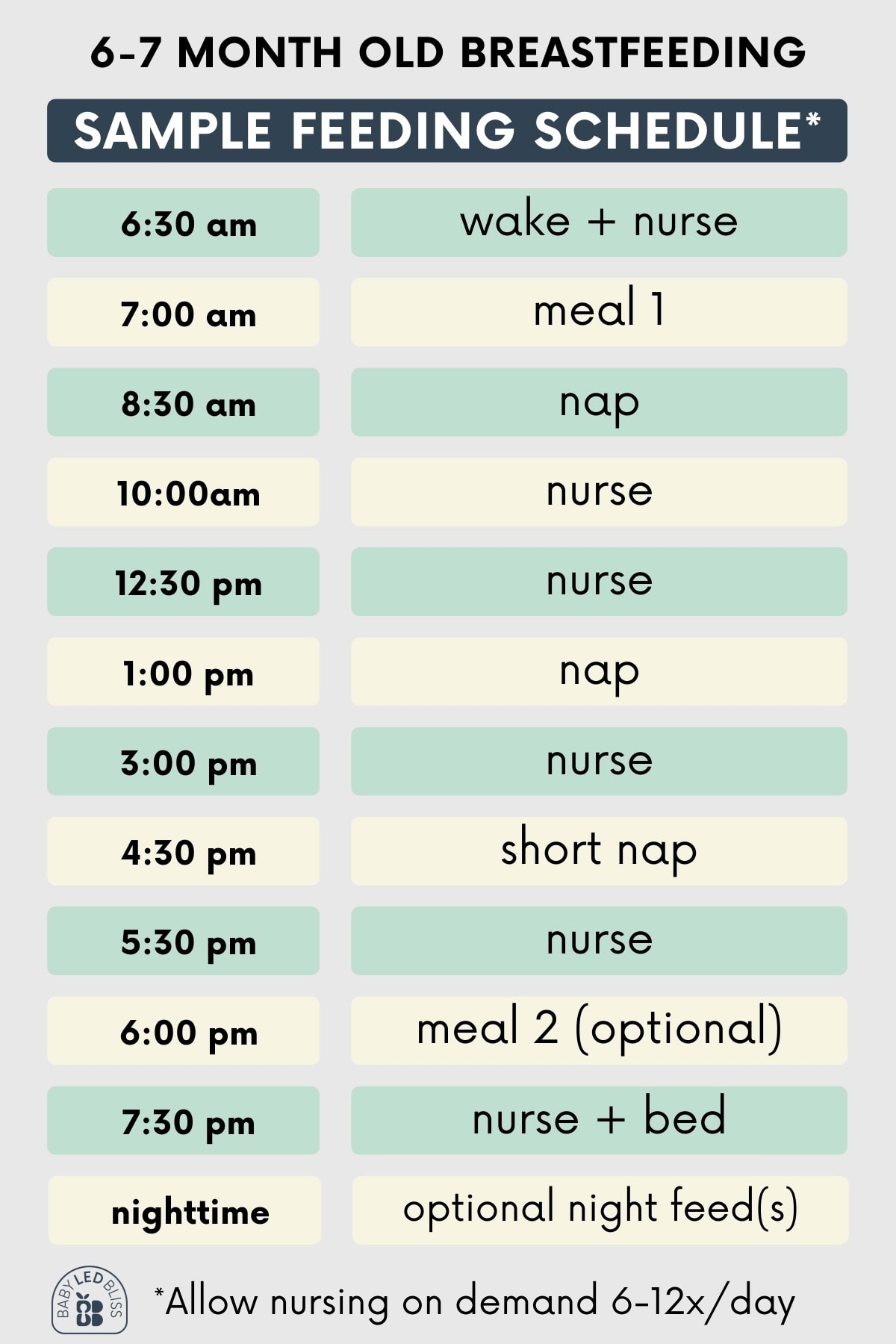
Breastfeeding Sample Schedule for 6-7 Month Old Babies
It's hard to tell (or remember, for mom!) sometimes how long baby is nursing or how often if you're breastfeeding on demand. Anywhere from 6-12 feeds a day at this age is normal, and baby may still be waking 1-2 times in the night to nurse. This is a loose example, and your schedule may not necessarily be the same. That's totally fine! As long as baby has an appropriate number of wet and dirty diapers is growing well, and thriving it's likely that your schedule is working just fine and baby is getting enough milk.
Volume of milk: It's hard to know exactly how many ounces breastfed babies are taking in.
Feeds per day: Anywhere from 6-12
Meals per day: 1-2
Naps: 3
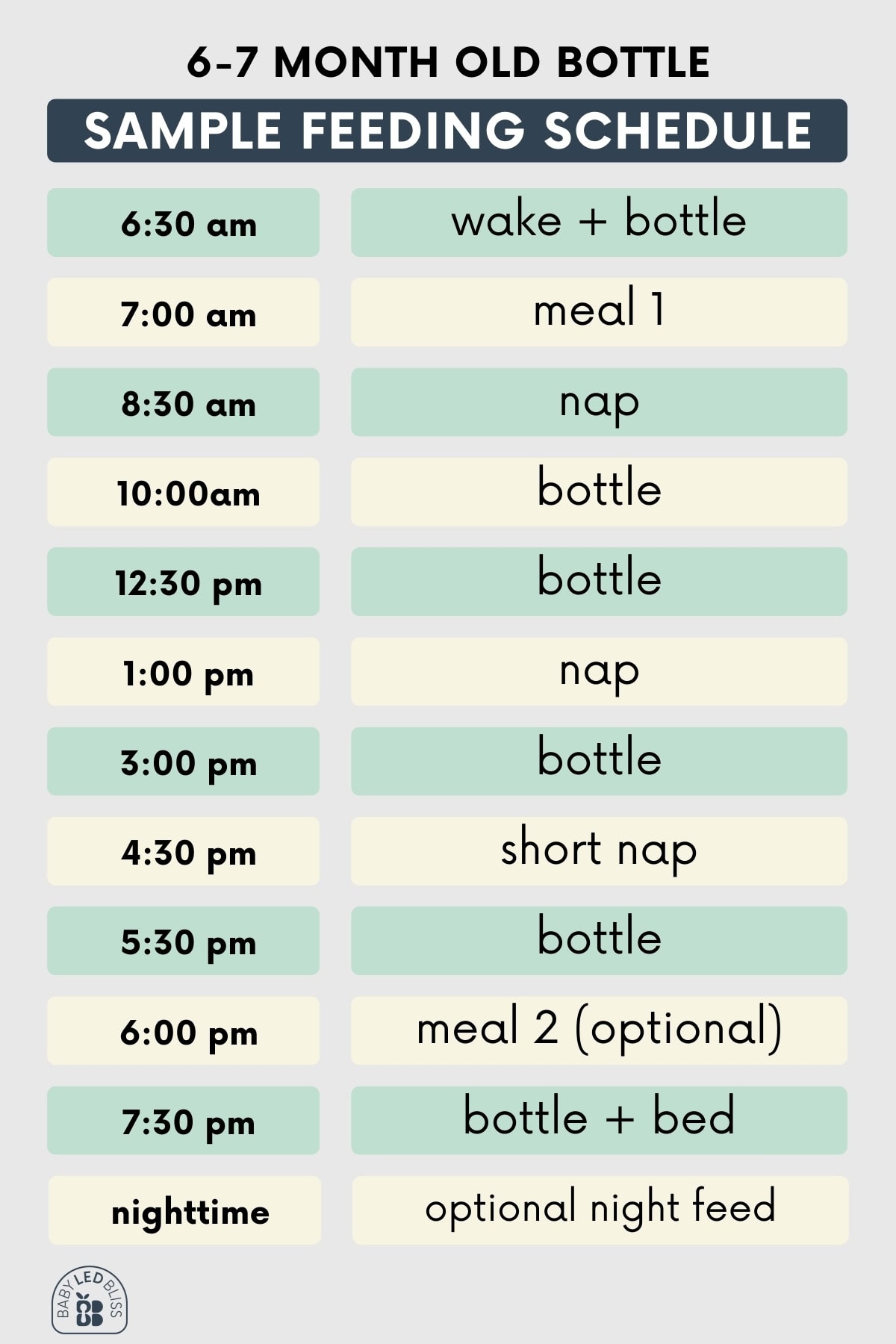
Bottle Feeding Sample Schedule for 6-7 Month Old Babies
At 6 months old, baby is likely getting 6-8 bottles of expressed breastmilk or formula each day, and you likely have a somewhat predictable schedule. Baby also may be taking a bottle during the night. You can stick to that schedule for the next couple of months as you introduce solid foods. This is a loose example, and your schedule may not necessarily be the same. As long as baby has an appropriate number of wet and dirty diapers and is growing well, it's likely that your schedule is working just fine and baby is getting enough milk.
If baby seems uninterested in solid foods, he may be coming to the table full. If you want baby to be more hungry at mealtimes, offer half of the bottle before a meal as an 'appetizer' and then feed the rest after the meal if needed. As baby starts to consume more food, the volume of milk consumed may decrease just a bit, but it likely will not until baby starts eating bigger portions at 8-9 months of age.
Volume of pumped milk or formula: roughly 24 to 32 fluid ounces (710 to 946 milliliters) per day
Feeds per day: 6-8
Meals per day: 1-2
Naps: 3
Bottom Line
When baby first starts solids at 6 months of age, and through months 7 and even 8, breastfeeding and bottle feeding schedules may not change all that much. Breastmilk or formula are still the primary source of nutrition, you're just adding new opportunities for babies to practice eating skills and explore new foods 1-2 times per day. Don't stress too much about it at this point, just try to have fun! Though if baby doesn't seem too interested in solid foods by about 8 months of age, you may need to change things up.

Leave a Reply